For Loop Optimisation: Parsing Tick Data at Speed
Two Loops, Two Philosophies
Following on from my previous post, Building a Backtesting Engine in C++, I started to evaluate data ingest performance from QuestDB. I want the C++ application to evaluate a strategy off a (git) branch, ingest the last n months of data, to spawn multiple sweeps as fast as possible.
I started off with a convenient loop, building a vector of PriceData.
The Convenient Loop
for (const auto& row : result) {
    double value1 = row[0].as<double>();
    double value2 = row[1].as<double>();
    std::string timestamp_str = row[2].as<std::string>();
    auto timestamp = Utilities::parseTimestamp(timestamp_str);
    results.emplace_back(value1, value2, timestamp);
}
This reads naturally. libpqxx's as<double>() and as<std::string>() handle the conversion for you. The problem is what's hidden behind that convenience:
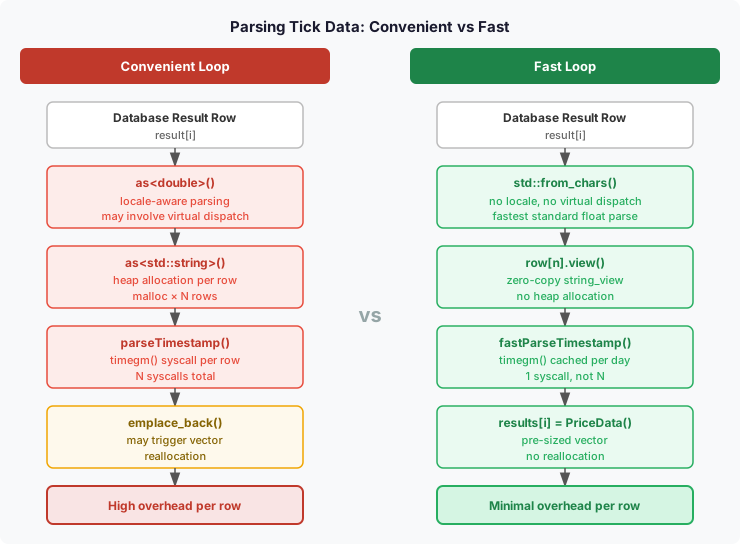
as<std::string>()constructs a heap-allocated string for every single timestamp, one malloc per row.as<double>()routes through libpqxx's general-purpose parsing machinery, which is locale-aware and may involve virtual dispatch.parseTimestamp()likely callstimegm()on every row to convert a calendar date into an epoch, an expensive syscall-adjacent operation.
The Fast Loop
I then explored optimisations, using string_view to avoid heap allocations and parsing floats directly with std::from_chars.
for (int i = 0; i < (int)result.size(); ++i) {
    const auto& row = result[i];
    double value1, value2;
    auto sv1 = row[0].view();
    auto sv2 = row[1].view();
    std::from_chars(sv1.data(), sv1.data() + sv1.size(), value1);
    std::from_chars(sv2.data(), sv2.data() + sv2.size(), value2);
    results[i] = PriceData(value1, value2, fastParseTimestamp(row[2].c_str()));
}
std::from_charsparses floats directly from astring_view, no allocation, no locale, no virtual dispatch. It's one of the fastest float-parsing routines in the standard library.fastParseTimestampusessscanfto extract the date components and then caches the result oftimegmper calendar day. For tick data where millions of rows share the same date, the expensive date-to-epoch conversion happens once, not millions of times. Subsequent rows simply add hours, minutes, and seconds to that cached base.- Pre-sizing
results[i]avoids repeated reallocation thatemplace_backcan cause if the vector isn't reserved.
fastParseTimestamp
The timestamp caching is the most impactful optimisation in the fast loop, so it's worth looking at in full:
static std::chrono::system_clock::time_point fastParseTimestamp(const char* ts) {
    int year, month, day, hour, min, sec, usec = 0;
    std::sscanf(ts, "%4d-%2d-%2d %2d:%2d:%2d.%d", &year, &month, &day, &hour, &min, &sec, &usec);

    // Cache timegm per date, tick data is time-ordered so date changes rarely
    static char cachedDate[11] = {};
    static time_t cachedEpoch = 0;
    if (std::memcmp(ts, cachedDate, 10) != 0) {
        std::memcpy(cachedDate, ts, 10);
        std::tm tm = {};
        tm.tm_year = year - 1900;
        tm.tm_mon  = month - 1;
        tm.tm_mday = day;
        tm.tm_isdst = 0;
        cachedEpoch = timegm(&tm);
    }

    time_t t = cachedEpoch + hour * 3600 + min * 60 + sec;
    return std::chrono::system_clock::from_time_t(t) + std::chrono::microseconds(usec);
}
The key insight is the static cache. timegm() converts a broken down calendar date into a Unix epoch. it's not a free operation, and calling it on every tick row is wasteful when tick data is time-ordered and millions of consecutive rows share the same date.
The cache works by comparing only the first 10 characters of the timestamp string (the YYYY-MM-DD portion) against the previously seen date using memcmp. If the date hasn't changed, cachedEpoch is reused directly and the hours, minutes, and seconds are simply added as an integer offset. timegm() is only called when the date actually rolls over typically once per trading day.
The function also handles sub-second precision via the usec field, returning a std::chrono::system_clock::time_point with microsecond resolution, which is the granularity needed for tick-level backtesting.
Data Flow Comparison
When Does It Matter?
For general-purpose applications, the first loop is the right choice. It's readable, maintainable, and the performance cost is negligible.
But for high-frequency financial data market tick ingest, order book replay, backtesting pipelines. I'm routinely processing tens of millions of rows per session. At that scale, eliminating one heap allocation and one timegm call per row isn't premature optimisation. It's the difference between a pipeline that keeps up with the feed and one that doesn't.
The core insight is that the bottleneck is often not the obvious work (parsing a float), but the hidden overhead, allocating a string only to pass it to something that reads it and throws it away. Profiling tick data pipelines almost always surfaces string construction as a top contributor.